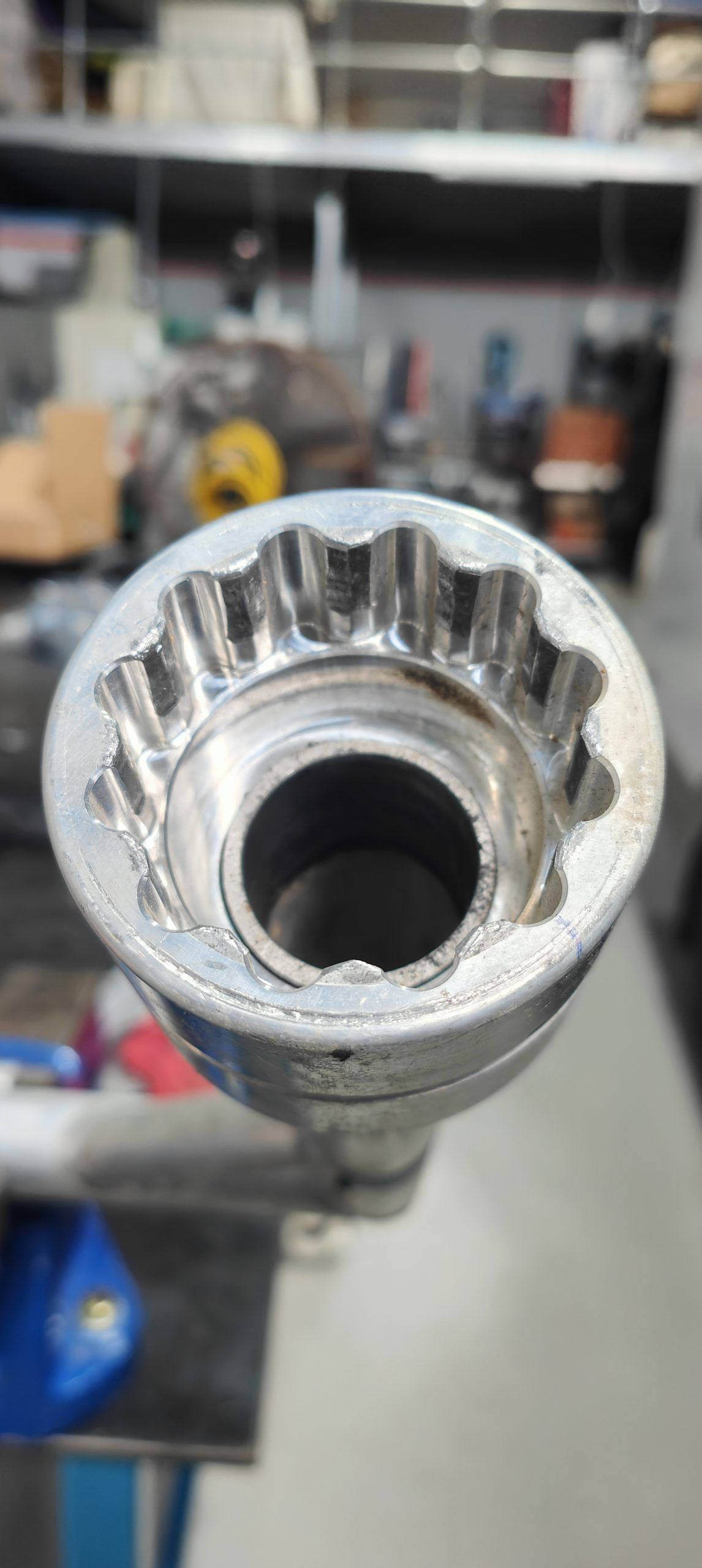
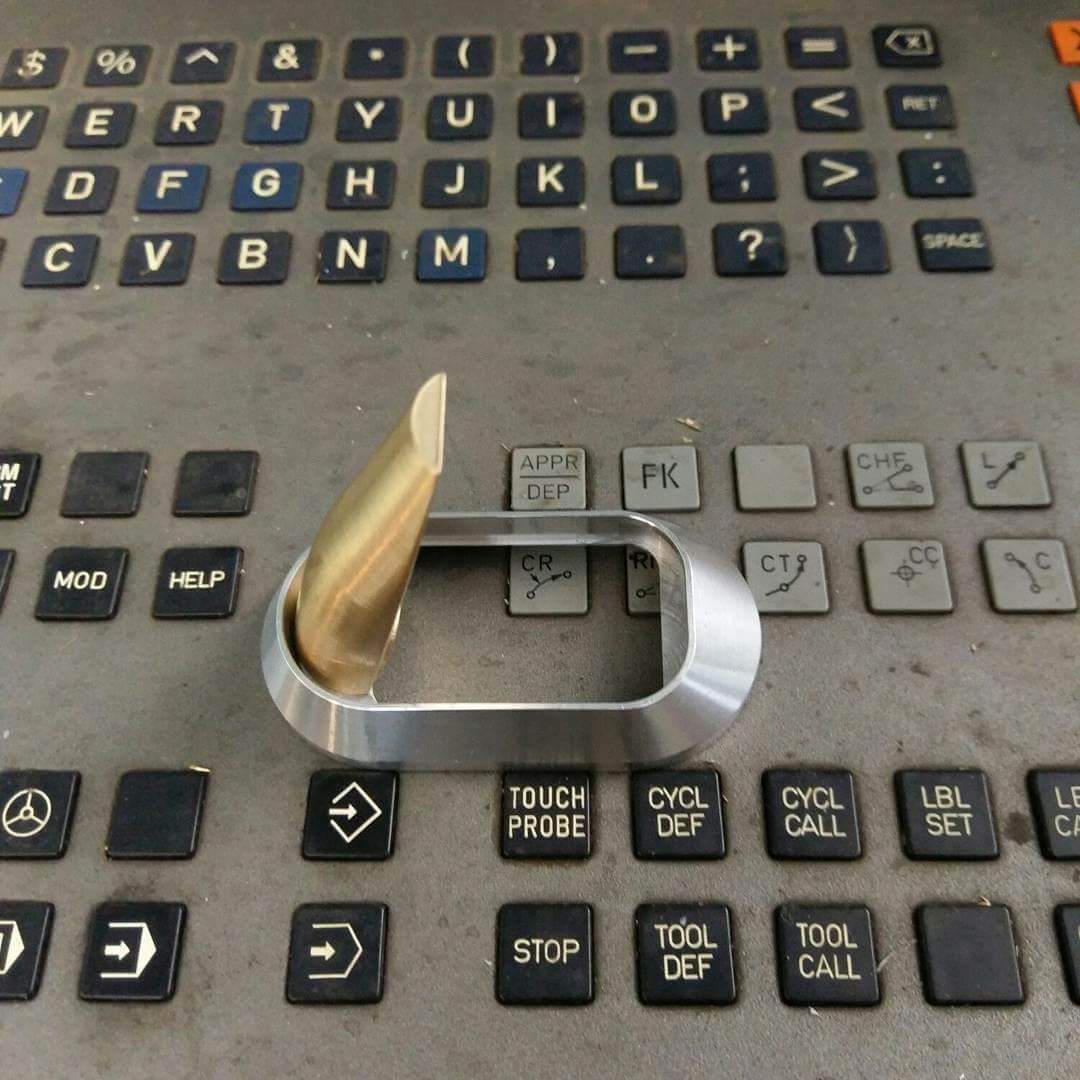
Most CNC machines move in three directions. Our main machine moves in five, and that difference is the whole reason a complex part can come off the table finished in one clamping instead of being flipped, re-fixtured and chased across several setups. Here is how the DMU 50T does it, and why it matters for the parts that come out of it.
The DMU 50 line traces back to Deckel Maho, the German builder whose universal milling machines became the DMU series under DMG Mori. Ours is the 50T: a 5-axis universal machining centre built around a swivel rotary table.
Three axes, then two more
Every milling machine has the three linear axes. The part sits on the table and moves relative to a spinning cutter along three straight lines at right angles to each other: X side to side, Y front to back, Z up and down. A standard 3-axis machine stops there, which means it can only ever cut the faces pointing up at the tool. To reach another side, you stop, unclamp, turn the part over and start again.
A 5-axis machine adds two rotary axes on top of the three linear ones. On the DMU 50T those two are built into the table itself, not the spindle.
| Axis | Type | Motion |
|---|---|---|
| X | Linear | Side to side — 500 mm |
| Y | Linear | Front to back — 450 mm |
| Z | Linear | Spindle up and down — 400 mm |
| B | Rotary | Table tilts through a wide arc |
| C | Rotary | Table rotates a full 360° |
The swivel rotary table is the key
On the DMU 50T the spindle stays vertical. It does not gimbal or swing. Instead, the part is reoriented underneath it by the table, which both tilts (the B-axis) and spins (the C-axis). Tilt the table over and rotate it, and a single fixed spindle can suddenly reach the sides, the angled faces and the back of a part without anyone touching the clamp.
This is what is called a table-table configuration: both rotary axes live on the workholding side. The trade-off is that it suits small-to-medium parts that fit and balance on the table, and in return you get a very rigid setup — the cutting forces feed straight down into the table rather than out through a swinging head. For the kind of work that comes through the shop, brackets, fittings, manifolds, restoration parts, that rigidity is exactly what you want.
Two ways to use the axes: 3+2 and full 5-axis
Having five axes does not mean all five are always moving. There are two distinct ways to cut, and most jobs use the first.
- 3+2, or positional machining. The two rotary axes tilt and rotate the part to a fixed compound angle, then lock. The cut itself is then done with the three linear axes, exactly like normal milling, just presented to the tool at the perfect angle. This is how you machine five faces of a part in one setup: index to a face, cut it, index to the next.
- Full simultaneous 5-axis. Here all five axes move at once, continuously, so the tool stays in the ideal contact with a curved or organic surface as it travels. This is what you need for shapes that are not made of flat faces — blended fillets, impeller-style forms, sculpted contours — where the tool angle has to keep changing through the cut.
Rule of thumb: every time a part comes off the machine and goes back on, you risk losing your reference and stacking up error. 5-axis exists to keep the part on the table, located once, until it is finished.
Why one setup beats five
The headline benefit of 5-axis is not exotic shapes. It is doing more in a single clamping, and that pays off in four concrete ways.
- Accuracy. Every re-clamp reintroduces alignment error. Cutting all the features in one setup means they are all referenced to the same zero, so hole-to-hole and face-to-face tolerances hold across the whole part.
- Access. Angled holes, undercuts and features on five faces become reachable without building special fixtures or flipping the part and hoping it relocates perfectly.
- Finish. Tilting the part lets us present a shorter, more rigid tool at the right angle instead of reaching in with a long, chattering one. Shorter tools cut cleaner, so there is less hand finishing afterward.
- Turnaround. Fewer setups means less manual handling and faster delivery, which is most of what you feel as a customer.
What the DMU 50T handles
| Spec | DMU 50T |
|---|---|
| Type | 5-axis universal machining centre |
| Linear travel (X / Y / Z) | 500 × 450 × 400 mm |
| Rotary axes | B-axis swivel table + C-axis 360° |
| Spindle | Up to 9,000 rpm |
| Materials | Aluminium, steel, stainless, brass |
| CAM | Autodesk Fusion 360 |
From Fusion 360 to the spindle
A 5-axis part starts as a 3D model. In Fusion 360 we build the toolpaths, then simulate the whole program before any metal is cut. Simulation matters far more on a 5-axis machine than a 3-axis one, because the part is tilting and rotating close to the spindle and fixtures, and a collision check on screen is a lot cheaper than one in the machine. Once the toolpaths are clean, the program is posted to the machine's control, the part is probed to find its exact position on the table, and the cut begins. The result is a part that was located once and machined complete.